Some dismissals take a moment to register. A stumping at 0.08 seconds does not give you that moment.
The ball arrives. The gloves move. The bails are gone. The batter is walking before the crowd has reacted.
The fastest stumping in cricket history is that quick.
Fastest Stumping in Cricket History
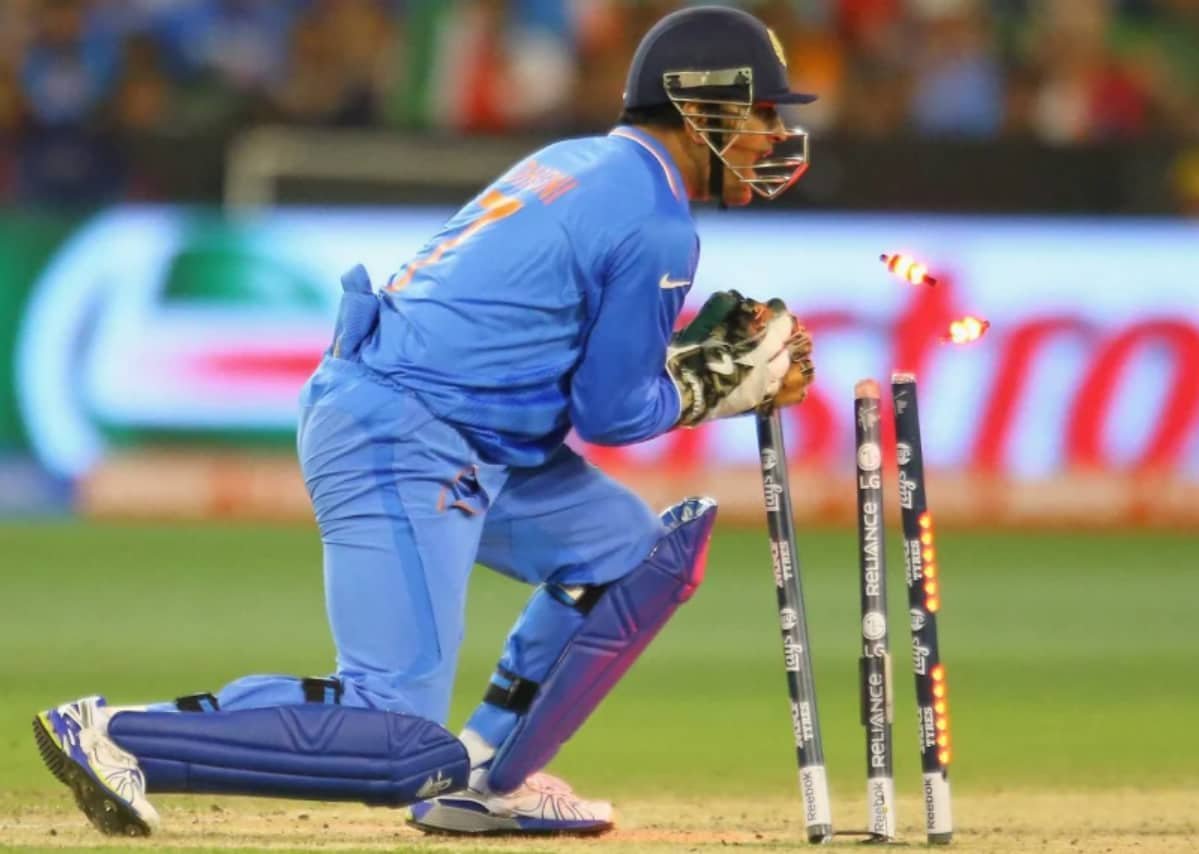
This list ranks all 10 of the fastest ever recorded, with timings, context, and the wicketkeepers who pulled them off.
The Complete Top 10: Fastest Stumping in Cricket History
| Rank | Wicketkeeper | Country | Time | Batter | Match Type | Year |
|---|---|---|---|---|---|---|
| 1 | MS Dhoni | India | 0.08s | Keemo Paul | ODI | 2018 |
| 2 | MS Dhoni | India | 0.09s | Mitchell Marsh | T20I | 2012 |
| 3 | Ben Cox | England | 0.10s | Callum McLeod | T20 Blast (Domestic) | 2018 |
| 4 | MS Dhoni | India | 0.10s | Shubman Gill | IPL Final | 2023 |
| 5 | Brendon McCullum | New Zealand | 0.11s | Ricky Ponting | ICC World Cup | 2011 |
| 6 | MS Dhoni | India | 0.12s | Suryakumar Yadav | IPL | 2025 |
| 7 | Kumar Sangakkara | Sri Lanka | 0.13s | Jimmy Maher | VB Series | 2003 |
| 8 | Kumar Sangakkara | Sri Lanka | ~0.13s | Brian Lara | ICC World Cup | 2007 |
| 9 | Mark Boucher | South Africa | ~0.14s | Marwan Atapattu | Bilateral Series | 2006 |
| 10 | Adam Gilchrist | Australia | ~0.14–0.15s | Craig McMillan | Bilateral Series | 2005 |
How Is Stumping Speed Measured?
A stumping is timed from the moment the ball hits the wicketkeeper’s gloves to the moment the bails are dislodged.
Modern broadcast technology and slow-motion cameras now capture this to the hundredth of a second.
To put those numbers in perspective: the average human blink takes 0.3 seconds. Dhoni’s record is 0.08 seconds.
He completed the stumping in roughly a quarter of the time it takes to blink.
Ranked: Every Record in Detail
1. MS Dhoni – 0.08 Seconds | India vs West Indies ODI, 2018
The record that stands alone.
Dhoni stumped Keemo Paul in an ODI against the West Indies in 2018.
The broadcast team had to slow the replay down multiple times just to show viewers what happened. At 0.08 seconds, the action was invisible in real time.
His gloves were already moving as the ball passed the bat. That is not reaction speed. That is anticipation built over 15 years behind the stumps.
2. MS Dhoni – 0.09 Seconds | India vs Australia T20I, 2012
The second fastest stumping in cricket history is also Dhoni’s.
He stumped Mitchell Marsh in 0.09 seconds during a T20I against Australia in 2012.
Six years before his record, Dhoni was already operating at a level no one else could match.
The 0.01-second gap between first and second on this list is the margin of a generation.
3. Ben Cox – 0.10 Seconds | T20 Blast, England, 2018
This one surprises people. Ben Cox is not an international name. He kept wicket for Worcestershire in the domestic T20 Blast competition.
His stumping of Callum McLeod in 0.10 seconds places him equal third on this list, ahead of most international keepers who have ever played the game.
Domestic cricket rarely gets credit for producing moments like this. Cox earned his place here.
4. MS Dhoni – 0.10 Seconds | IPL Final, CSK vs GT, 2023
Age does not appear on Dhoni’s CV.
At 42 years old, in a high-pressure IPL final, Dhoni stumped Shubman Gill in 0.10 seconds.
Chennai Super Kings won the match. This stumping played a part in that win.
The fact that Dhoni was performing at this level, in a final, at that age, makes this one of the most impressive entries on the list.
5. Brendon McCullum – 0.11 Seconds | ICC World Cup, 2011
Brendon McCullum had one of cricket’s most complete profiles: aggressive opener, brilliant keeper, and fearless leader.
His stumping of Ricky Ponting in the 2011 ICC World Cup showed all of that in 0.11 seconds.
Ponting was stepping out for an attack. McCullum read the shot, collected the ball, and had the bails off before Ponting could recover.
Stumping a future Hall of Famer in a World Cup takes composure most keepers never develop.
6. MS Dhoni – 0.12 Seconds | IPL 2025, CSK vs MI
Still there. Still faster than almost everyone.
In IPL 2025, at 43 or 44 years old, Dhoni stumped Suryakumar Yadav in 0.12 seconds.
Suryakumar is one of T20 cricket’s most destructive batters. He was gone before he could react.
Four entries. Thirteen years apart. The same hands.
7. Kumar Sangakkara – 0.13 Seconds | VB Series, Australia, 2003
Kumar Sangakkara gave up the gloves midway through his career to focus on batting full-time. Before that, he was world-class behind the stumps.
His stumping of Jimmy Maher in 0.13 seconds in the 2003 VB Series in Australia shows what Sri Lanka lost when he stopped keeping.
Doing it in Australia, against an Australian batter, on Australian pitches, takes more than quick hands.
8. Kumar Sangakkara – ~0.13 Seconds | ICC World Cup, 2007
The name on the other end of this one matters.
Sangakkara stumped Brian Lara in approximately 0.13 seconds at the 2007 ICC World Cup.
Lara is widely regarded as one of the greatest batters in cricket history.
Stumping him in a World Cup match is the kind of moment that defines a wicketkeeper’s career. For Sangakkara, it is one of many.
9. Mark Boucher – ~0.14 Seconds | Bilateral Series, 2006
Mark Boucher holds the record for most Test dismissals by a wicketkeeper. His hands were fast, and his positioning was almost always right.
In a 2006 bilateral series, Boucher stumped Marwan Atapattu in approximately 0.14 seconds.
Clean, efficient, and utterly typical of the standard he maintained across more than a decade of international cricket for South Africa.
10. Adam Gilchrist – ~0.14–0.15 Seconds | Bilateral Series, 2005
Adam Gilchrist did not just keep wickets. He reshaped how the position was understood.
An attacking number seven batter who also kept at the highest level across all formats.
In a 2005 bilateral series, Gilchrist stumped Craig McMillan of New Zealand in approximately 0.14–0.15 seconds.
During the era when Australia dominated world cricket, Gilchrist was the heartbeat of both their batting and their keeping.
Three Patterns This List Reveals
- 1. Dhoni is in a class of his own. Four entries, spanning 2012 to 2025. The fastest, the second fastest, and two more in the top six. No other wicketkeeper is close.
- 2. Domestic cricket produces elite talent. Ben Cox’s presence at number three shows that stumping speed at the highest level is not exclusive to international cricket. Some of the sharpest hands never play a Test match.
- 3. Great wicketkeepers perform in big moments. McCullum stumped Ponting at a World Cup. Sangakkara stumped Lara at a World Cup. Dhoni stumped Gill in an IPL final. The pressure did not slow them down. It did not seem to register at all.
FAQs
- Who holds the fastest stumping record in cricket?
MS Dhoni, with a time of 0.08 seconds against Keemo Paul in an ODI against the West Indies in 2018.
- What is the 2nd fastest stumping in cricket history?
Also, MS Dhoni, at 0.09 seconds, stumping Mitchell Marsh in a T20I against Australia in 2012.
- How many times does MS Dhoni appear in the top 10 fastest stumpings?
Four times: at 0.08s (2018), 0.09s (2012), 0.10s (2023), and 0.12s (2025).
- Is there any domestic cricketer in the top 10 fastest stumping list?
Yes, Ben Cox of Worcestershire stumped Callum McLeod in 0.10 seconds in the 2018 T20 Blast. He is equal third on the all-time list.
- How is stumping speed measured?
Broadcast technology and slow-motion cameras capture the time from when the ball reaches the wicketkeeper’s gloves to when the bails are removed, measured in hundredths of a second.
- Was Dhoni still performing elite stumpings late in his career?
Yes. His 2023 IPL final stumping at age 42 (0.10s) and his 2025 IPL stumping at age 43-44 (0.12s) both rank in the global top 10 all time.
Conclusion:
The fastest stumping in cricket history is 0.08 seconds by MS Dhoni in 2018. That record is untouched.
But this list is not just about Dhoni. It is about the wicketkeepers who combined fast hands with smart positioning, match composure, and years of preparation.
From Gilchrist to Sangakkara to a Worcestershire keeper most fans have never heard of, every entry on this list earned its place.
These are the quickest in history. And 0.08 seconds is still the number to beat.
Also Check:
- Fastest Balls In IPL History
- Fastest 5000 Runs in ODIs
- Fastest Centuries in ODIs Cricket History
- Fastest Century in T20 World Cup History
- Fastest Centuries in T20Is Cricket History
About the Author
