A T20I hundred scored in thirty-five balls isn’t just quick batting. It’s calculated chaos.
The bowler knows what’s coming. The fielding captain has already moved everyone to the boundary.
Yet the batsman still finds gaps, still clears the rope, still punches the air after reaching three figures before most openers settle in.
Fastest centuries in T20Is cricket history aren’t accidents. T
hey’re built on risk assessment, pitch reading, and the ability to hit twelve different scoring zones without breaking rhythm.
Some came in chases. Others came batting first, setting impossible targets. All of them redefined what’s possible in a format designed for aggression.
Fastest Centuries in T20Is Cricket History
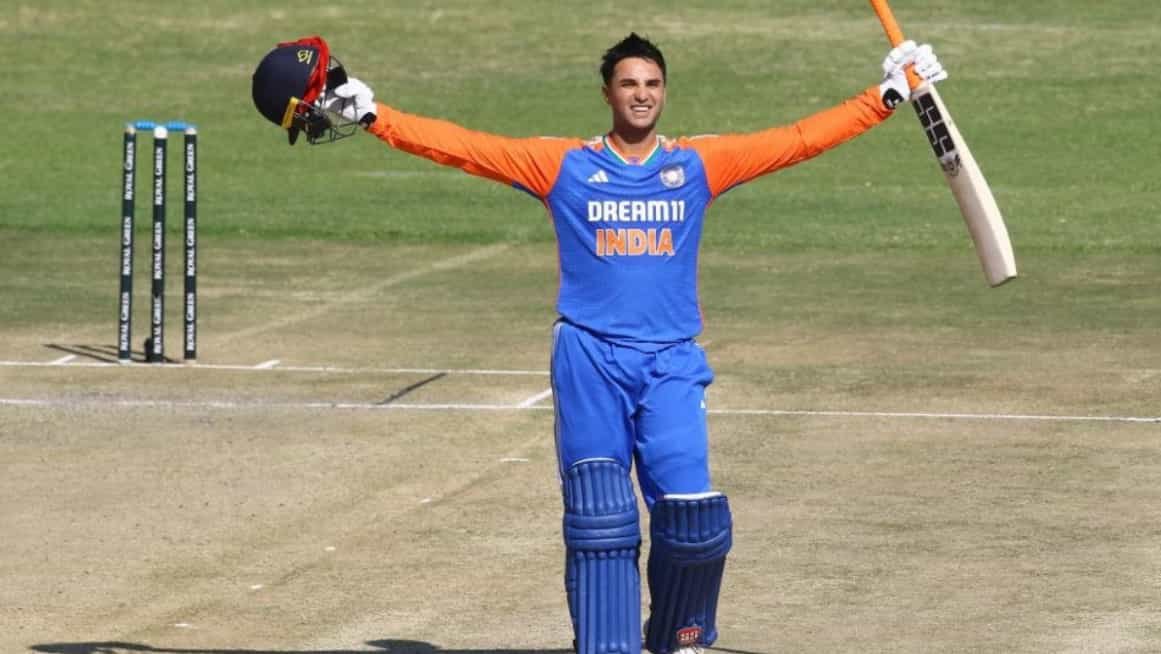
Fastest Centuries in T20Is Cricket History
What Makes a T20I Century “Fast”?
- Speed in T20I hundreds is measured purely by balls faced, not minutes at the crease. A fifty-ball hundred is ordinary in this format.
- A forty-ball century turns heads. Anything under thirty-five balls rewrites records.
- The difference between a fast century and a regular T20I hundred often comes down to five or six dot balls.
- A batsman facing thirty balls with zero dots can reach a hundred if he scores at least seventeen boundaries.
- That’s the mathematical reality.
- The tactical reality is different. Bowlers don’t bowl six bad balls every over.
- Field restrictions end after six overs. Spinners bowl into the pitch on wearing surfaces.
- The fastest centuries happen when batsmen eliminate dots entirely while maintaining boundary percentage above fifty percent.
- They don’t just hit sixes.
- They work singles into gaps, convert twos into threes by running hard, and punish anything remotely hittable. It’s batting at its most efficient.
Top 5 Fastest Centuries in T20Is Cricket History
| Rank | Player | Balls Faced | Opposition | Year | Venue |
|---|---|---|---|---|---|
| 1 | Sahil Chauhan (Estonia) | 27 | vs Cyprus | 2024 | Episkopi |
| 2 | Sudesh Wickramasekara (Sri Lanka) | 35 | vs Mongolia | 2023 | Hangzhou |
| 3 | Jan Nicol Loftie-Eaton (Namibia) | 33 | vs Nepal | 2024 | Kirtipur |
| 4 | David Miller (South Africa) | 35 | vs Bangladesh | 2017 | Potchefstroom |
| 5 | Rohit Sharma (India) | 35 | vs Sri Lanka | 2017 | Indore |
1. Sahil Chauhan – 27 Balls (Estonia vs Cyprus, 2024)
- Sahil Chauhan’s twenty-seven-ball century stands as the fastest hundred in T20 International cricket history. Playing for Estonia against Cyprus in a T20I European qualifier, Chauhan dismantled the bowling attack with ruthless efficiency. He cleared the boundary eleven times and hit seven fours, reaching his hundred in just twenty-seven deliveries.
- The context matters here. This wasn’t India versus Australia at the MCG. It was a European Cricket Championship match between developing cricket nations. The bowling quality wasn’t world-class. The pressure wasn’t comparable to a World Cup knockout. But the record is official, recognized by the ICC, and it stands.
- Chauhan’s strike rate crossed 370 during this innings. That’s nearly four runs per ball. He didn’t waste a single delivery. Every ball was either a boundary or rotated for quick singles. The Cyprus bowlers had no answers. By the time they adjusted their lengths, Chauhan was already past his fifty.
2. Sudesh Wickramasekara – 35 Balls (Sri Lanka vs Mongolia, 2023)
- Sudesh Wickramasekara needed thirty-five balls to reach his hundred during the 2023 Asian Games. Sri Lanka faced Mongolia in Hangzhou, and Wickramasekara batted like someone who understood the gulf in class. He hit fourteen sixes and four boundaries, finishing with 120 runs.
- This innings came in an Asian Games match, which carried T20I status. Mongolia’s bowling attack lacked experience at this level. Wickramasekara capitalized without mercy. His fifty came off nineteen balls. His next fifty took just sixteen more deliveries.
- The Asian Games format gave Full Member nations opportunities to pad statistics against weaker opposition. Wickramasekara’s century is legitimate, but it’s worth noting the context when comparing it to hundreds scored against top-tier bowling attacks.
3. Jan Nicol Loftie-Eaton – 33 Balls (Namibia vs Nepal, 2024)
- Jan Nicol Loftie-Eaton smashed a thirty-three-ball century for Namibia against Nepal in Kirtipur. This was the fastest T20I century at the time before being surpassed. Loftie-Eaton’s innings was brutal. He hit twelve sixes and seven fours, dismantling Nepal’s bowling on their home ground.
- Namibia needed quick runs, and Loftie-Eaton delivered. His approach wasn’t reckless. He identified the weaker bowlers, targeted short boundaries, and executed clean hitting. The hundred came before the fifteenth over ended.
- This innings showed that Associate nations can produce explosive batting performances. Loftie-Eaton proved he could dominate in conditions that typically favor spinners. His strike rotation between boundaries kept the scoreboard ticking even when he wasn’t clearing the rope.
4. David Miller – 35 Balls (South Africa vs Bangladesh, 2017)
- David Miller’s thirty-five-ball century remains the fastest hundred in T20 International cricket history by a player from a Full Member nation against another Full Member nation. That distinction matters. Playing against Bangladesh in Potchefstroom, Miller reached his century with nine sixes and seven fours.
- Bangladesh’s bowlers tried everything. They went wide outside off. They bowled yorkers. They changed pace. Miller adjusted to every variation. His ability to hit straight sixes off good-length balls separated this innings from typical T20 hitting.
- The match situation added pressure. South Africa needed quick runs to set a defendable target. Miller delivered under that pressure, showing why he’s considered one of the cleanest strikers in T20 cricket. His century helped South Africa post a massive total that Bangladesh never threatened.
5. Rohit Sharma – 35 Balls (India vs Sri Lanka, 2017)
- Rohit Sharma matched Miller’s record the same year, scoring a thirty-five-ball century against Sri Lanka in Indore. This remains the fastest T20 international century by an Indian batsman. Rohit hit twelve sixes and five fours, punishing Sri Lankan bowlers on a flat Indore pitch.
- Rohit’s hundred showcased his range. He didn’t just muscle the ball. He timed it. His pull shots went flat and hard over midwicket. His lofted drives cleared long-off comfortably. When bowlers adjusted, he used the pace and guided deliveries past backward point.
- The Indore pitch offered nothing to bowlers. Short boundaries and a true surface made it a batsman’s paradise. Rohit capitalized completely, demonstrating why he’s one of the most destructive T20 openers ever produced.
Top 10 Fastest Centuries in T20Is Cricket History
Beyond the top five, several other batsmen have scored centuries in under forty balls. Chris Gayle holds multiple spots in extended lists.
Glenn Maxwell, Aaron Finch, and Colin Munro have also registered lightning-quick hundreds that changed match outcomes within minutes.
The tenth-fastest century in T20I history came in approximately thirty-nine to forty balls.
That time frame is still extraordinary. To understand how fast these innings are, consider that most T20I teams score around 160-170 in twenty overs. These batsmen reached personal hundreds in less than seven overs.
Tactical View: Reading the Fast Hundred
- Fast T20I centuries share common patterns. They typically happen on flat pitches with fast outfields. They occur when fielding restrictions favor batsmen or when bowling attacks lack variation. They also happen when batsmen reach a mental state where risk calculation switches off and instinct takes over.
- The psychological aspect matters more than people realize. A batsman on forty off eighteen balls faces a choice every delivery. Play smart and finish on eighty off thirty-five, or keep attacking and risk getting out for fifty. The fastest centuries belong to batsmen who never second-guess aggression. They commit to attacking mode and stick with it regardless of consequences.
- Pitch behavior plays a crucial role. True bounces allow batsmen to trust their shots. Slow, gripping surfaces force batsmen to manufacture power rather than time the ball. Every record-breaking T20I century has come on surfaces offering consistent bounce and pace.
Fastest Century in ODI vs T20I: Understanding Format Differences
- The fastest century in ODI cricket came off thirty-one balls, scored by AB de Villiers against West Indies in 2015. Comparing ODI and T20I centuries reveals interesting contrasts.
- ODI hundreds require sustained aggression over longer periods. T20I hundreds demand instant explosion with almost zero recovery time between boundaries.
- In ODIs, batsmen can build toward a fast century.
- They play themselves in during powerplay, accelerate during middle overs, and explode in the death. In T20Is, there’s no time for gradual acceleration. Batsmen must attack from ball one or risk running out of deliveries.
- The fastest hundred in cricket history across all formats happened in T20 domestic cricket, not international cricket. But among internationally recognized matches, T20Is and ODIs dominate the record books for speed.
Expert Insight: Why Some Records Feel Different
- Not all fast centuries carry equal weight.
- A hundred against Mongolia or Cyprus, while officially recognized, doesn’t generate the same respect as a hundred against Australia or England. Cricket fans understand context.
- They know bowling quality varies dramatically between Full Members and Associates.
- This doesn’t invalidate the records. Sahil Chauhan’s twenty-seven-ball century is the official fastest.
- But when cricket historians discuss the greatest T20I innings, they’ll prioritize David Miller’s and Rohit Sharma’s hundreds because they came against established international attacks.
- The real measure of a fast century isn’t just balls faced. It’s who you faced, where you played, and what the match situation demanded.
- A forty-ball century chasing 200 in a World Cup knockout carries more significance than a thirty-ball century in a dead rubber against weak bowling.
Comparison: Full Member vs Associate Records
| Category | Fastest (Balls) | Player | Opposition Quality |
|---|---|---|---|
| Overall Fastest | 27 | Sahil Chauhan | Associate vs Associate |
| Full Member vs Full Member | 35 | David Miller / Rohit Sharma | Top-tier bowling |
| World Cup/Major Tournament | ~40-42 | Various | Knockout pressure |
This breakdown shows why context matters. The gap between twenty-seven balls and thirty-five balls is eight deliveries. But the gap in bowling quality, fielding standards, and match pressure is enormous.
FAQs
- Who scored the fastest century in T20 International cricket history?
Sahil Chauhan of Estonia holds the record with a twenty-seven-ball century against Cyprus in 2024.
- What is the fastest T20I century by a Full Member nation player?
David Miller and Rohit Sharma both scored thirty-five-ball centuries in 2017, the fastest by players from Full Member nations.
- How does the fastest T20I century compare to ODI?
The fastest ODI century is thirty-one balls by AB de Villiers, four balls faster than the fastest Full Member T20I century but slower than the overall T20I record.
- Who holds the fastest T20I century for India?
Rohit Sharma scored the fastest hundred in T20 international by an Indian, reaching three figures in thirty-five balls against Sri Lanka in 2017.
- Are all T20I records officially recognized regardless of opposition?
Yes, all T20Is sanctioned by the ICC count toward official records, whether played between Full Members or Associate nations.
Final Thoughts
The fastest centuries in T20Is cricket history tell different stories.
Some show the growing competitiveness of Associate cricket. Others demonstrate the peak capabilities of elite batsmen against world-class bowling. All of them prove that T20 cricket has redefined what’s possible in a single innings.
These records will keep falling. Pitches are getting flatter. Bats are getting bigger.
Batsmen are getting bolder. Somewhere, someone is practicing shots that haven’t been invented yet, preparing to break a record that currently seems impossible. That’s the beauty of T20 cricket. The fastest hundred hasn’t been scored yet.
Also Check:
About the Author
