Cricket throws numbers at you constantly. Run rates, averages, economy, it’s easy to get lost.
But if there’s one stat that tells you whether a player is dominating or struggling, it’s strike rate.
So what is the strike rate in cricket? It measures speed and efficiency. For batters, it shows scoring pace.
For bowlers, it reveals wicket-taking speed. The confusing part? They work in opposite ways.
What Is the Strike Rate in Cricket?
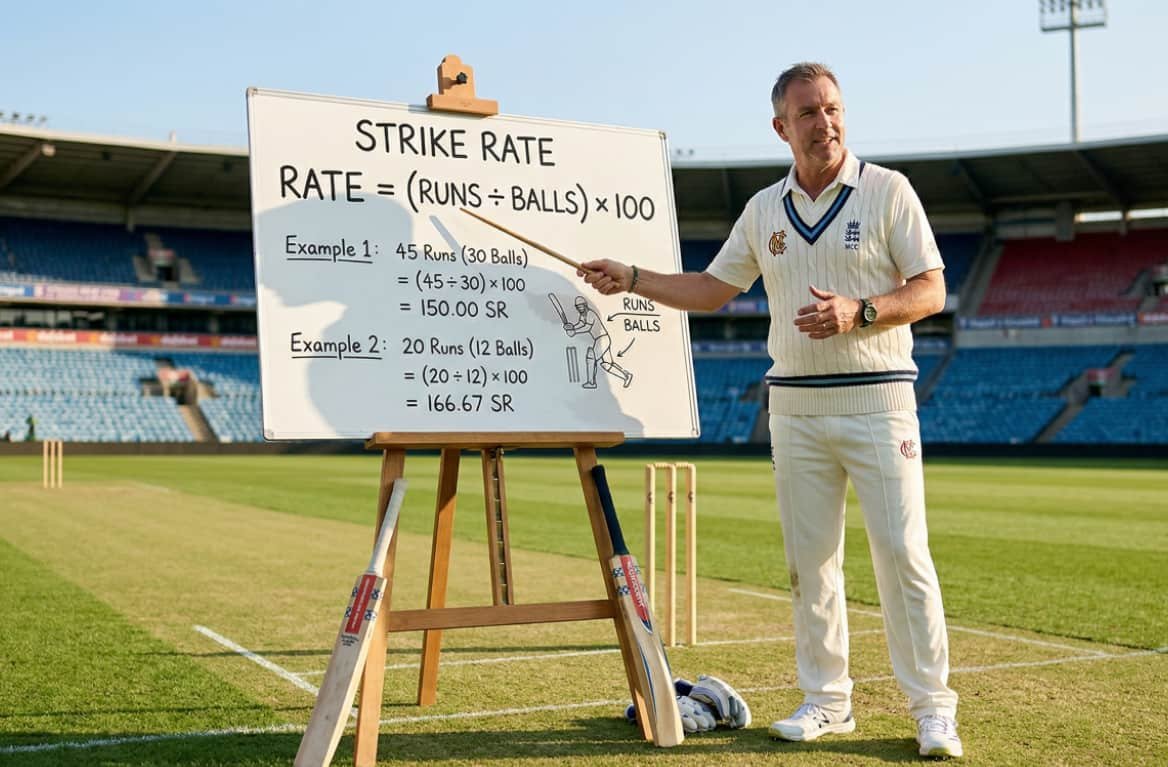
This guide breaks it down clearly. You’ll learn both formulas, see practical examples, understand what makes a good strike rate in different formats, and discover why this single stat has become cricket’s most talked-about metric.
Understanding Strike Rate: The Basics
Strike rate meaning in cricket changes based on who you’re measuring. The term covers two completely different calculations.
- For batters: Runs scored per 100 balls faced. Higher numbers mean faster scoring.
- For bowlers: Balls bowled per wicket taken. Lower numbers mean quicker wicket-taking.
This creates confusion for new fans. A batter with a strike rate of 140 is explosive. A bowler with a strike rate of 140 would be terrible. Context matters completely.
Think of it this way: Batters want to maximize runs before getting out. Bowlers want to minimize balls before taking wickets. The stats reflect those opposite goals.
What Is Strike Rate in Batting?
What is strike rate in batting? It’s how many runs a batter scores per 100 deliveries faced.
Batting Strike Rate Formula
Strike Rate = (Total Runs ÷ Balls Faced) × 100
Worked Example
A batter scores 68 runs off 44 balls:
- Strike Rate = (68 ÷ 44) × 100
- Strike Rate = 154.54
This means scoring roughly 155 runs per 100 balls, or 1.55 runs per delivery. That’s aggressive hitting by any standard.
Understanding the Numbers
- 50 strike rate = Half a run per ball (defensive, patient)
- 100 strike rate = One run per ball (balanced, run-a-ball)
- 150 strike rate = 1.5 runs per ball (aggressive)
- 200 strike rate = Two runs per ball (explosive power hitting)
Format dictates what’s acceptable. A strike rate of 60 in Test cricket shows positive intent. The same 60 in T20 cricket would be match-losing.
Bowling Strike Rate Explained
Bowling strike rate flips everything. Lower is better because it means taking wickets faster.
Bowling Strike Rate Formula
- Strike Rate = Total Balls Bowled ÷ Wickets Taken
Worked Example
A bowler delivers 132 balls and takes 6 wickets:
- Strike Rate = 132 ÷ 6
- Strike Rate = 22
This bowler takes a wicket every 22 balls, or roughly every 3.6 overs. That’s excellent in any format.
Why Lower Beats Higher
Cricket rewards wicket-taking. A bowler striking every 35 balls is more effective than one striking every 55 balls, assuming similar conditions.
Test matches especially value low bowling strike rates. You need 20 wickets to win a Test. Bowlers who take them quickly are invaluable.
Format-Specific Strike Rate Expectations
Different formats demand completely different strike rates. What is the strike rate in cricket T20 versus Tests? Night and day difference.
Test Cricket Strike Rates
Tests reward patience over explosiveness.
- Batting: Strike rates of 45-55 are common. Defensive players might sit at 40. Aggressive batters push toward 65-75.
- Bowling: Strike rates of 55-65 balls per wicket are solid. Elite pacers like Jasprit Bumrah or Pat Cummins operate in the low 50s to high 40s.
ODI Cricket Strike Rates
One-day cricket balances aggression with stability.
- Batting: Modern batters target 90-105 strike rates. Top players regularly exceed 100, meaning run-a-ball or faster throughout their innings.
- Bowling: Taking wickets every 32-38 balls is good. But economy rate (runs per over) matters equally in ODIs.
T20 and IPL Strike Rates
What is the strike rate in cricket IPL? Explosive and constantly rising.
- Batting: Successful T20 batters maintain 130-150 strike rates. Power hitters like Kieron Pollard or Andre Russell push 165-180.
- Bowling: With just 24 balls to bowl, strike rate matters less than economy. But powerplay wickets (first 6 overs) are gold, making early strike rates crucial.
What Is a Good Strike Rate in Cricket?
“Good” depends entirely on format and role.
Batting Benchmarks
| Format | Acceptable | Good | Excellent |
|---|---|---|---|
| Test | 45-55 | 60-70 | 75+ |
| ODI | 75-85 | 90-105 | 115+ |
| T20 | 110-125 | 130-150 | 160+ |
Bowling Benchmarks
| Format | Acceptable | Good | Excellent |
|---|---|---|---|
| Test | 60-70 | 50-60 | Under 50 |
| ODI | 38-45 | 30-37 | Under 30 |
| T20 | 20-24 | 16-20 | Under 16 |
Remember: Role affects expectations. Openers in Tests often have lower strike rates than middle-order hitters. Death bowlers in T20s might have higher strike rates than new-ball bowlers.
Record Strike Rates in T20 Cricket
Highest strike rate in T20 international cricket belongs to power hitters who redefined aggressive batting.
Among batters with meaningful careers (500+ runs):
- Andre Russell (West Indies): Career T20I strike rate around 165-170. He’s made impossible hitting look routine.
- Glenn Maxwell (Australia): Maintains career rates near 155-158. Known for reverse sweeps and innovative shot-making.
- Tim David (Australia): Emerging finisher with strike rates above 160, specializing in death-over hitting.
Single-innings records climb even higher. Players have posted strike rates exceeding 300 in brief cameos, hitting almost exclusively boundaries.
For bowling, T20 focuses more on economy than strike rate. But taking wickets in the powerplay in under 15 balls is highly valuable.
How to Calculate Strike Rate
Already covered both formulas, but here’s your quick reference:
For Batting
Strike Rate = (Runs Scored ÷ Balls Faced) × 100Quick calculation: Scored 45 runs off 32 balls?
(45 ÷ 32) × 100 = 140.62 strike rate
For Bowling
Strike Rate = Balls Bowled ÷ Wickets TakenQuick calculation: Bowled 96 balls, took 4 wickets?
96 ÷ 4 = 24 balls per wicket
Strike Rate Calculator Tools
Don’t want to calculate manually? Use these:
- ESPNcricinfo: Auto-calculates on every scorecard
- Cricbuzz: Live strike rate tracking during matches
- IPL Official App: Season-by-season player strike rates
- Google: Type “cricket strike rate calculator” for instant tools
Most cricket apps and websites calculate automatically. But knowing the formula helps you understand what the numbers mean.
Why Strike Rate Dominates Modern Cricket?
Cricket has changed dramatically in the past 20 years. T20 leagues exploded globally. The IPL became a billion-dollar business. Franchise cricket now rivals international cricket for attention and money.
This shift made strike rate king. IPL teams pay massive auction fees for batters with 140+ strike rates. A player averaging 35 with a 150 strike rate might earn more than someone averaging 45 with a 110 strike rate.
Even Test cricket has evolved. Teams chase results rather than playing for draws. Batters like Brendon McCullum and Ben Stokes pushed strike rates higher, changing how Test cricket is played.
For bowlers, taking wickets in clusters swings matches. A bowler with a 45 strike rate can dismantle batting lineups before they settle.
Strike rate in cricket transformed from a secondary stat into a primary factor in player valuation, team selection, and match tactics.
Frequently Asked Questions
- What’s the difference between strike rate and average in cricket?
Strike rate measures the speed at which you score or take wickets. Average measures consistency—runs per dismissal for batters, runs per wicket for bowlers. A player can have a high strike rate but a low average if they score quickly and then get out.
- Is 130 a good strike rate in T20 cricket?
Yes, 130 is acceptable in T20s, though top players target 140-160. A 130 strike rate means scoring 1.3 runs per ball, which helps post competitive totals. Elite finishers and power hitters exceed 160.
- How do you calculate batting strike rate?
Divide runs scored by balls faced, then multiply by 100. The strike rate formula is: (Runs ÷ Balls) × 100. Example: 50 runs off 35 balls = (50 ÷ 35) × 100 = 142.85 strike rate.
- Who has the best strike rate in IPL history?
Among players with substantial innings (500+ runs), Andre Russell holds one of the highest IPL career strike rates at around 177-180. Other explosive hitters like Sunil Narine and Tim David also maintain rates above 165.
- What is a good bowling strike rate in Test cricket?
A good Test bowling strike rate is 50-60 balls per wicket. Elite fast bowlers operate in the 40s. Anything under 50 is excellent—it means taking a wicket roughly every 8 overs.
- Why is strike rate more important in T20 than Tests?
T20 cricket has limited overs (20 per team). Scoring quickly maximizes runs in that short window. Tests have unlimited time, so building big scores through patience works. Format constraints make strike rate crucial in T20s but secondary to average in Tests.
Conclusion:
What is the strike rate in cricket? For batters, it’s runs per 100 balls, higher means faster scoring. For bowlers, it’s balls per wicket—lower means quicker wicket-taking.
The formula is simple. The interpretation changes completely by format. A strike rate that’s excellent in Tests might be ordinary in T20s. Context always matters.
Understanding strike rate helps you read cricket better. When you see a T20 batter stuck at 105 while chasing 180, you know they’re behind the pace.
When a Test bowler strikes every 48 balls, you know they’re consistently dangerous.
Watch cricket with strike rates in mind. They reveal whether players are winning their individual battles or falling behind in the race against time and opposition.
About the Author
