Understanding the Mulpani cricket ground pitch report helps teams plan their strategy effectively.
The surface in Kathmandu favors bowlers, particularly spinners who can exploit the slow, low bounce.
Teams visiting this venue face unique challenges.
The pitch doesn’t offer the pace and carry typical of most international grounds.
Batters need patience and smart shot selection.
Aggressive cricket without proper groundwork rarely succeeds here.
Mulpani Cricket Ground Pitch Report
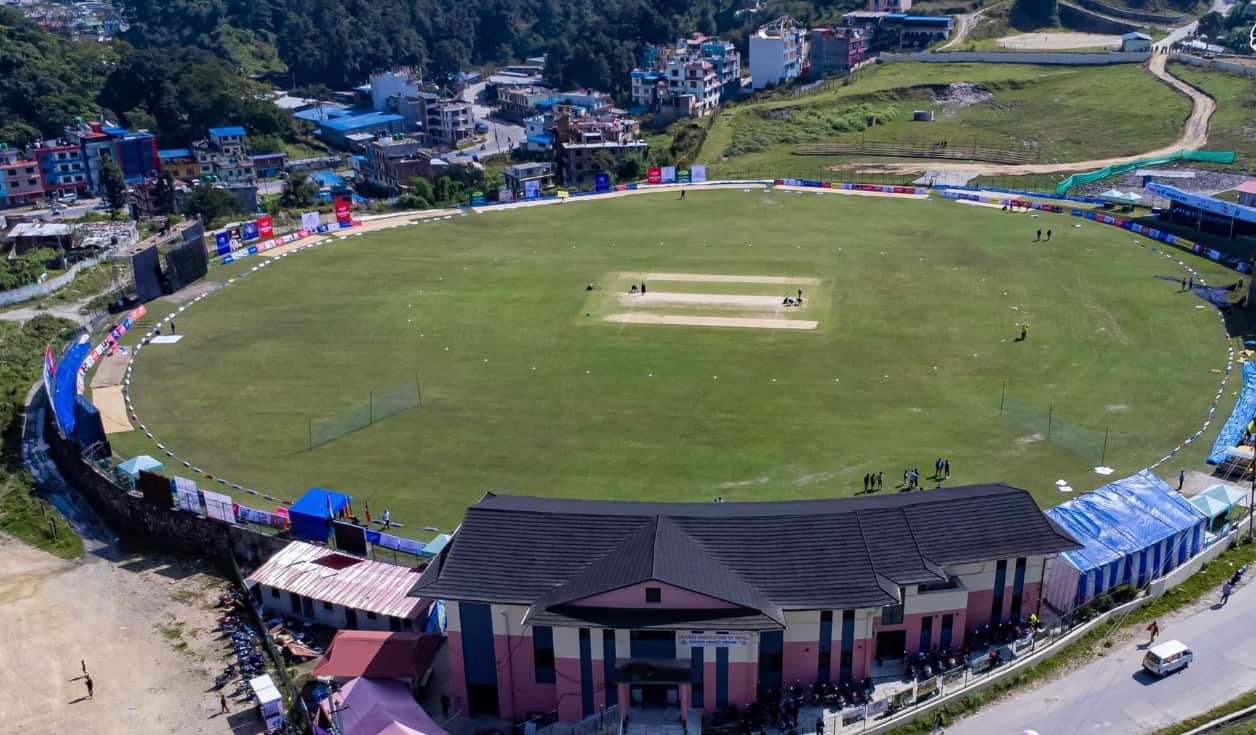
Venue Profile and Basic Information
Mulpani Cricket Stadium serves as Nepal’s premier international cricket venue.
Located in a suburban area near Kathmandu, it represents the country’s cricket development efforts.
The Cricket Association of Nepal operates the facility. It’s designed to host ODIs, T20Is, and domestic competitions.
| Feature | Information |
|---|---|
| Stadium Name | Mulpani Cricket Stadium |
| Location | Mulpani, Kathmandu, Nepal |
| Managed By | Cricket Association of Nepal |
| Seating Capacity | Approximately 15,000 |
| Pitch Type | Natural grass wicket |
| Floodlights | Available |
| Playing Ends | Mulpani End, City End |
The stadium includes modern facilities for players and spectators. Floodlights enable day-night matches, expanding scheduling options.
Playing Area Dimensions
The ground features medium-sized dimensions suitable for international cricket. Boundary lengths are balanced across all sides.
Straight boundaries stretch 72-75 meters. These longer boundaries make straight hitting challenging.
Square boundaries measure 60-68 meters. Players can target these areas for quicker runs.
Key measurements:
- Straight boundary: 72-75 meters
- Leg side: 65-68 meters
- Off side: 66-70 meters
- Back side: 70-73 meters
These dimensions create a fair contest. Power hitters can’t dominate without proper technique and timing.
Match Statistics Across Formats
T20 Cricket Records
Twenty-three T20 matches have been played at Mulpani. The data shows interesting patterns about pitch behavior.
Teams bowling first hold a slight edge with 12 wins. Batting first, teams won 11 matches.
| T20 Record | Figure |
|---|---|
| Matches Played | 23 |
| Batting First Wins | 11 |
| Bowling First Wins | 12 |
| First Innings Average | 142 |
| Second Innings Average | 130 |
| Top Score | 213/6 |
| Lowest Score | 90 |
| Best Chase | 165 |
| Best Defense | 115 |
First innings scores average 142 runs. Second innings drop to 130, indicating the surface gets tougher.
The highest total of 213/6 proves big scores are achievable. The lowest of 90 shows how the pitch can bite when conditions suit bowlers.
Successfully chasing 165 represents the best run chase. Defending just 115 runs demonstrates how spinners can strangle batting lineups.
ODI Performance Data
Only one ODI match has occurred at Mulpani. The batting first team scored 236 and defended successfully.
The chasing team managed 190 runs. This 46-run margin suggests that setting targets works well in the longer format.
More matches are needed for reliable patterns. The single game provides limited insight.
Test Match Status
Mulpani hasn’t hosted any Test cricket yet. The venue currently lacks ICC Test status.
Nepal continues working toward Test cricket recognition.
Future infrastructure improvements might bring this format to Kathmandu.
Mulpani Cricket Ground Pitch Report Today: Surface Breakdown
The pitch plays slowly with minimal bounce. Batters struggle to time shots, especially when attempting aggressive strokes.
Fast bowlers get some help early. The ball carries through to the keeper in the first few overs.
As the match progresses, the pace drops. Spinners become increasingly effective as the surface grips.
Stroke play demands patience. Quick runs don’t come easily, particularly during middle overs when spinners operate.
Early Match Conditions
The first six overs offer decent carry. Fast bowlers can trouble batters with good-length bowling.
Movement through the air is possible. Swing bowlers should exploit the new ball phase.
Batters need careful footwork. The low bounce makes drives risky without proper positioning.
Middle Overs Battle
Spinners dominate overs 7-15 in T20s. The ball grips and turns, making run-scoring difficult.
Batters must rotate the strike effectively. Boundaries become rare as bowlers tighten their grip.
Variations work brilliantly here. Slower balls and cutters deceive batters consistently.
Death Overs Strategy
Pace returns for the final overs. However, the pitch still favors variations over pure speed.
Yorkers prove most effective. Batters can’t generate power easily on this surface.
Teams setting totals should target 140-145 in T20s. These scores are competitive and often defensible.
Toss Impact and Winning Patterns
The Mulpani cricket ground pitch report scorecard reveals that bowling first wins 52% of matches. Batting first claims 48%.
This four-point difference isn’t huge. However, it suggests a genuine advantage exists.
Day Match Analysis
Morning games are played on the pitch at its slowest. Spinners get assistance from the start.
Bowling first wins approximately 55% of day matches. Batting first, teams win 45%.
Captains prefer chasing the dew-free conditions.
Consistent bounce throughout helps with planning run chases.
Day-Night Match Dynamics
Evening starts offer slightly easier batting. Set batters can score runs if they survive the middle overs.
Dew rarely affects play. Both innings face similar conditions.
Win percentages balance at 50-50 for night matches. Team composition matters more than the toss.
Tactical View: Reading Match Situations
Teams need specific game plans for Mulpani. Standard approaches often fail on this unique surface.
Batting units should prioritize partnerships over quick runs. Wickets in hand matter more than strike rates through the middle phase.
Consider this scenario: A team reaches 65/2 after 10 overs in a T20 match. They need 80 runs from the final 10 overs with 8 wickets remaining.
The set batters push too hard, losing three wickets in two overs trying to accelerate.
Suddenly, they’re 82/5 after 12 overs, and the required rate has climbed despite scoring runs. The pitch doesn’t allow recovery from such collapses.
Smart captains recognize this trap. They keep wickets in hand, allowing natural acceleration once batters are set.
Bowling captains should use spinners extensively. Even part-time spinners can be effective here.
Field settings need adjustment. With shorter square boundaries, protecting gaps becomes vital.
The psychological battle intensifies in close chases. Batters know boundaries are hard to find.
This knowledge creates pressure, leading to poor shot selection.
Bowlers gain confidence as the pitch slows. They sense batters struggling and attack more aggressively.
Climate and Weather Conditions
Kathmandu’s weather varies significantly across seasons. Understanding these patterns helps with match preparation.
Summer months (March to May) see temperatures of 25-30°C. Occasional rain can interrupt play.
Winter (October to February) provides ideal cricket conditions. Temperatures range from 5-20°C with minimal rain.
Monsoon season (June to September) brings heavy rainfall. Scheduling matches becomes difficult during these months.
The best cricket weather occurs between October and February. Dry conditions and moderate temperatures create comfortable playing environments.
Common Questions About Mulpani
- What type of pitch is Mulpani Cricket Ground?
It’s a bowling-friendly pitch that particularly helps spinners and bowlers using variations.
- What’s the average T20 score at Mulpani?
First innings average is 142 runs, while the second innings average drops to 130 runs.
- Should teams bat or bowl first here?
Bowling first has a slight advantage, winning 52% compared to 48% for batting first.
- How many international matches has Mulpani hosted?
The venue has hosted 23 T20 matches and 1 ODI match.
- What are the boundary dimensions?
Straight boundaries are 72-75 meters, while square boundaries measure 60-68 meters.
Strategic Preparation for Teams
Visiting teams need specific practice sessions. Working on spin batting becomes essential.
Batters should focus on strike rotation. Finding singles and twos suits this pitch better than boundary hunting.
Bowlers must develop variations. Having multiple slower deliveries helps on surfaces lacking natural pace.
Local knowledge provides significant advantages. Nepal’s players understand exactly how the pitch behaves at different stages.
Touring teams face adaptation challenges. Quick adjustment separates successful campaigns from disappointing ones.
The venue continues developing its international cricket profile. More matches will reveal additional patterns and characteristics.
Teams willing to adapt their natural game succeed here. Those trying to force aggressive cricket against pitch conditions usually struggle.
Also Check:
About the Author
