Your fantasy team looks perfect on paper. Three proven bowlers, all with solid economy rates. Then you check the venue.
Chinnaswamy Stadium. Suddenly, those same bowlers don’t look safe anymore. And you’re right to worry.
The M. Chinnaswamy Stadium IPL pitch report reveals conditions that systematically favour batters in ways most IPL venues simply don’t match.
M. Chinnaswamy Stadium IPL Pitch Report
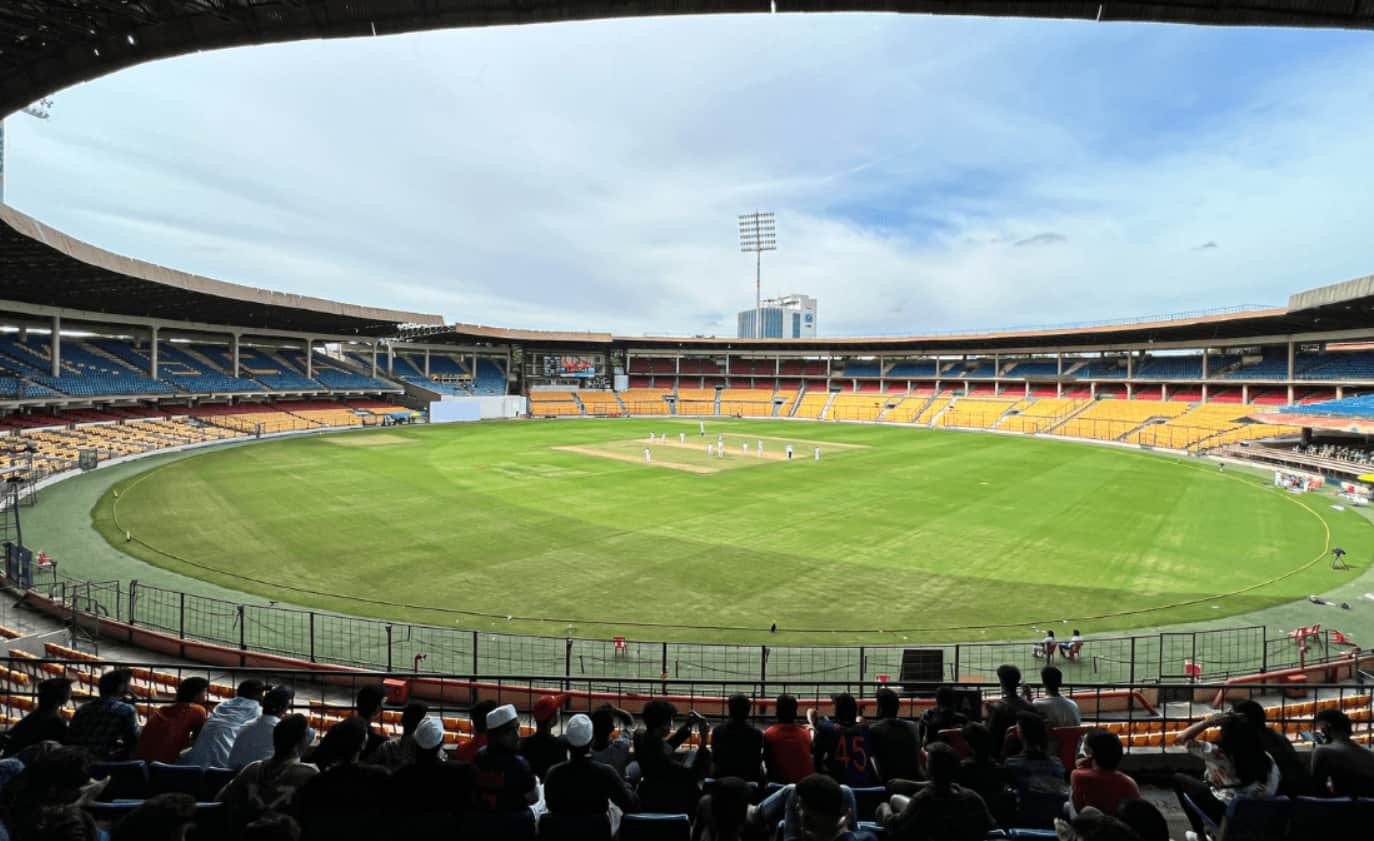
What the M Chinnaswamy Stadium IPL Pitch Report Tells Us?
The pitch at Chinnaswamy doesn’t change from match to match. It’s prepared the same way for every IPL game, creating consistent conditions that batters trust and bowlers fear.
Hard surface, true bounce, minimal seam movement. These three factors combine to create one of the most batter-friendly environments in professional T20 cricket.
Unlike Chennai, where the pitch deteriorates and starts gripping by the tenth over, Chinnaswamy stays flat throughout twenty overs. Unlike Kolkata, where pace and bounce vary unpredictably, this surface offers consistency.
That consistency is exactly what makes it dangerous for bowlers. Batters know what they’re getting. They commit earlier to shots. They generate higher bat speed. They score faster.
M Chinnaswamy Stadium IPL Pitch Report Today: Live Match Factors
When checking the M Chinnaswamy Stadium IPL pitch report today before a live match, focus on three specific factors:
- Weather conditions: Humidity levels above 70% almost guarantee heavy dew after sunset. That dew makes the second innings significantly easier for batters.
- Recent rainfall: Even light rain 24 hours before the match can add moisture to the outfield, making it faster. Balls race to the boundary with less effort required.
- Temperature: Evening temperatures below 22°C increase dew probability. Check forecasts, not just current conditions.
The pitch itself won’t surprise you. But environmental factors around it can shift match dynamics dramatically.
Core Stats: M Chinnaswamy Stadium Average Score in IPL
| Scoring Phase | Par Score Range |
|---|---|
| **Powerplay** (Overs 1-6) | 52-62 runs |
| Middle Phase (Overs 7-15) | 95-110 runs total |
| **Death Overs** (Overs 16-20) | 65-75 runs in this phase |
| Complete First Innings | 185-200+ runs |
| M Chinnaswamy Stadium average Score in IPL | 176.4 runs |
Notice the powerplay average sits 10-12 runs higher than typical IPL venues. That gap compounds through the innings.
By the halfway mark, teams are already 15-20 runs ahead of standard venue pars. By the death overs, totals regularly push past 200.
Historical Data: M Chinnaswamy Stadium IPL Records
The M Chinnaswamy Stadium IPL records paint a clear picture of this venue’s nature:
- Highest team total: 263/5 (RCB vs Pune Warriors, 2013). Chris Gayle demolished the bowling attack with 175 off 66 balls. Thirteen fours, seventeen sixes.
- Lowest total defended successfully: 131/5 (RCB vs KKR, 2008). Different era, slower scoring rates, less aggressive batting approaches.
- Biggest successful chase: 215/1 (CSK vs RCB, 2022). Devon Conway and Ruturaj Gaikwad made it look routine on a dewy evening.
- Best individual bowling: 5/18 by Yuzvendra Chahal. Notice it came from a leg-spinner who relies on skill, not surface assistance.
These extremes show both the ceiling and the floor. The pitch enables massive scores but doesn’t guarantee them. Execution still determines outcomes.
Reading the M Chinnaswamy Stadium IPL Pitch Report Scorecard
When analyzing the M chinnaswamy stadium ipl pitch report scorecard during live matches, watch these specific indicators:
- First six overs: If teams score 60+ in the powerplay, expect 200+ totals. The pitch is playing true, and batters are confident.
- Wickets in middle overs: Three or fewer wickets lost between overs 7-15 signals the pitch isn’t offering anything to bowlers. Expect big totals.
- Boundary frequency: If boundaries come every 2-3 balls rather than every 4-5 balls, the conditions heavily favour batting. Adjust expectations upward.
- Bowler body language: Watch how bowlers carry themselves by the tenth over. Slumped shoulders and defensive fields signal they’ve accepted that high scoring is inevitable.
These visual cues matter as much as raw numbers on the scorecard.
Chinnaswamy Stadium Pitch Report Batting or Bowling Analysis
The Chinnaswamy Stadium pitch report batting or bowling question has one clear answer: extremely batting-dominant.
But here’s what matters more than the label. It’s how that dominance manifests tactically.
Batters can play through the line from ball one. The bounce is predictable. They don’t need to “feel out” the pitch for three overs. They attack immediately.
Virat Kohli exemplifies this approach. His cover drives off the front foot work because he trusts the bounce completely. No hesitation, no second-guessing.
Bowlers, meanwhile, arrive with a mental deficit. They know their best deliveries might still disappear. That knowledge breeds defensive thinking, which batters exploit ruthlessly.
A good length ball at Wankhede might bring a mistimed shot. At Chinnaswamy, it gets driven through extra cover for four. Same delivery, different outcome.
| Toss Decision | Matches Won | Win Percentage |
|---|---|---|
| Bat First | ~33 matches | 41% |
| Chase | ~48 matches | 59% |
| Total Matches | 80+ matches | 100% |
The gap is significant. Chasing teams win nearly 60% of matches at this venue. That’s not a coincidence or a small sample size. That’s a structural advantage.
Dew explains part of this. Evening matches see heavy dew develop after 8:30 PM. The ball gets slippery. Spinners can’t grip it. Fast bowlers struggle with wet run-ups.
But even accounting for dew, target clarity matters. Chasing teams know exactly what’s required. They pace their innings accordingly. They know when to attack and when to consolidate.
Batting first means guessing par. Set 180, and you might be 15 short. Set 205, and you might have wasted wickets pushing unnecessarily.
Why Boundaries Matter: Dimensions Breakdown
| Boundary Area | Distance (metres) | Impact Level |
|---|---|---|
| Straight boundaries | 75-78m | Moderate |
| Square leg/cover | 65-68m | High |
| Backward square/fine leg | 62m | Extreme |
The backward square boundary at 62 metres is absurdly short for modern cricket. Any ball directed there carries serious boundary risk.
Pull shots don’t need perfect timing. Top edges clear the rope. Ramp shots over the keeper’s head find boundaries easily. Even mishits can go for six.
Glenn Maxwell exploits these dimensions perfectly. His reverse sweeps and switch hits target the short square boundary repeatedly. He’s scored 400+ runs at Chinnaswamy with a strike rate above 160.
Bowlers have nowhere safe. Bowl straight, get driven. Bowl short, get pulled. Bowl wide, get cut. The dimensions leave zero margin for error.
M Chinnaswamy Stadium IPL Pitch Report RCB Home Strategy
The M chinnaswamy stadium ipl pitch report rcb perspective, reveals interesting patterns.
RCB has played 40+ home matches here. They understand this venue better than any visiting team. That knowledge shows in their selection and tactics.
When batting first, RCB targets 200+ aggressively. They don’t settle for 180. They know their bowling attack needs maximum cushion given how the pitch behaves.
When chasing, they back their top order completely. Faf du Plessis, Virat Kohli, and Glenn Maxwell all have strong venue records. They know which ends bowlers struggle at.
Visiting teams often underprepare. They treat Chinnaswamy like any high-scoring venue without understanding the specific tactical adjustments required.
That’s where RCB gains an advantage. Local knowledge in IPL cricket matters more than people realize.
Expert Insight: Altitude’s Hidden Impact
Most pitch reports ignore altitude. That’s a mistake at Chinnaswamy.
Bengaluru sits at 920 metres above sea level. The air is thinner. Less resistance means balls travel 8-10% further than at sea level.
A shot that’s caught at Wankhede (sea level) clears the rope here. A six that travels 78 metres at Mumbai goes 85 metres at Bengaluru.
This affects every lofted shot. Batters don’t need a perfect connection. Even mis-hits carry to the boundary.
For fantasy cricket selections, this matters hugely. A power hitter who averages three sixes per match elsewhere might hit five at Chinnaswamy.
That’s 6-8 extra fantasy points just from altitude advantage.
Bowlers can’t compensate for this. They can’t make the air denser. They just accept smaller margins and hope for perfection.
Chinnaswamy Stadium Pitch Report Pre-Match Analysis
When you check Chinnaswamy Stadium pitch report or similar platforms before matches, you’ll see consistent themes:
- “Batting paradise expected”
- “Chasing teams have advantage”
- “Dew likely in second innings”
These are accurate but incomplete. What they miss is the psychological component.
Bowlers don’t just face physical challenges. They face mental pressure knowing their best balls might still get hit.
That creates hesitation, which leads to predictable bowling, which batters punish harder.
The pitch report gives you conditions. It doesn’t tell you how those conditions break bowling plans or inflate batting confidence.
That understanding comes from watching matches here repeatedly.
Top Performers Who’ve Mastered This Venue
Batters:
- Virat Kohli: 900+ runs at Chinnaswamy. His timing and placement game is built for this bounce.
- AB de Villiers: His 360-degree shotmaking exploited every boundary dimension here.
- Chris Gayle: That 175 remains the benchmark for destruction at this venue.
Bowlers:
- Yuzvendra Chahal: 30+ wickets through variations in flight and pace, not surface help.
- Mohammed Siraj: Early swing specialist who strikes before the pitch fully settles.
- Harshal Patel: A death overs expert whose slower balls and yorkers suit these conditions.
Notice the pattern. Successful bowlers don’t rely on pitch assistance. They create advantages through pure skill.
Fantasy Team Strategy for Chinnaswamy Matches
- Captain selection: Always pick a top-four batter. An opener scoring 75 at Chinnaswamy delivers 90-110 fantasy points with strike rate bonuses. No bowler matches that ceiling.
- Bowler choices: Pick wicket-takers, not economy specialists. A 3/45 performance beats 0/30 in fantasy scoring at this venue every time.
- Wicket-keeper priority: Select those batting in the top four positions. KL Rahul, Rishabh Pant, or Jos Buttler types who can exploit conditions fully.
- All-rounders value: Premium picks here. Someone batting at five and bowling 2-3 overs gives dual scoring opportunities.
- Avoid: Defensive spinners entirely. Their upside is too limited when par scores regularly exceed 185.
The key is accepting that traditional fantasy strategies don’t work here. You can’t build balanced teams. You need to lean heavily into batting dominance.
Comparing Chinnaswamy to Similar High-Scoring Venues
- Wankhede Stadium (Mumbai): Also high-scoring but offers bounce to pacers. Some assistance is available. Chinnaswamy offers nothing.
- Arun Jaitley Stadium (Delhi): Can be flat, but larger boundaries provide bowler protection. Chinnaswamy’s short squares remove that safety.
- Punjab Cricket Association Stadium (Mohali): Batting-friendly in powerplay but slows down later. Chinnaswamy stays true throughout.
Chinnaswamy sits at the end of the batting-friendly spectrum. It’s not just about high scores. It’s about how consistently it produces them.
FAQs: M. Chinnaswamy Stadium IPL Pitch Report
- Is the Chinnaswamy pitch good for batting in IPL?
Yes, extremely. The flat surface, true bounce, and short square boundaries make it one of the best batting venues in IPL. Teams regularly score 185-200+ runs here.
- What is considered a good score at M. Chinnaswamy Stadium?
190-200 is competitive. Anything below 180 is risky to defend. Teams chase 180+ regularly here. Totals above 200 give the batting-first team a genuine advantage.
- Why do teams prefer chasing at Chinnaswamy?
Chasing teams win 59% of matches. Dew helps second innings batting significantly. Target clarity allows better innings management. These factors combine to favour chasing strongly.
Which bowlers perform well at this venue?
Wicket-taking spinners with variations (like Yuzvendra Chahal), death specialists with yorker skills, and variation pacers succeed. Economy-focused bowlers struggle because the pitch offers zero assistance.
- How does altitude affect scoring at Chinnaswamy?
Bengaluru’s 920m altitude means thinner air. Balls travel 8-10% further than at sea level venues. This significantly helps batters on lofted shots and makes boundaries easier to clear.
Final Analysis: Understanding Chinnaswamy’s True Nature
Chinnaswamy doesn’t reward patience. It punishes hesitation. Teams that arrive planning conservative cricket lose. Teams that commit to attacking from ball one succeed.
The pitch characteristics won’t change. Groundstaff prepare it the same way for every match. Short boundaries stay short. Altitude remains constant. Dew develops on humid evenings.
What separates winners from losers is tactical acceptance. Accept you’ll probably concede 180+. Accept that bowlers will go for runs. Accepting defending 175 requires near-perfect execution.
Then build a strategy around those realities. Stack your batting order. Pick wicket-takers over economy bowlers. Chase when you win the toss.
For fantasy cricket, the approach is similar. Load up on aggressive top-order batters. Select all-rounders batting high. Avoid defensive specialists.
Understanding this venue changes how you watch IPL matches, build teams, and predict outcomes. Chinnaswamy isn’t just another batting paradise. It’s a specific tactical challenge requiring specific solutions.
Get those solutions right, and the numbers make sense. Ignore them, and you’ll keep wondering why your supposedly safe picks keep failing on this ground.
About the Author
