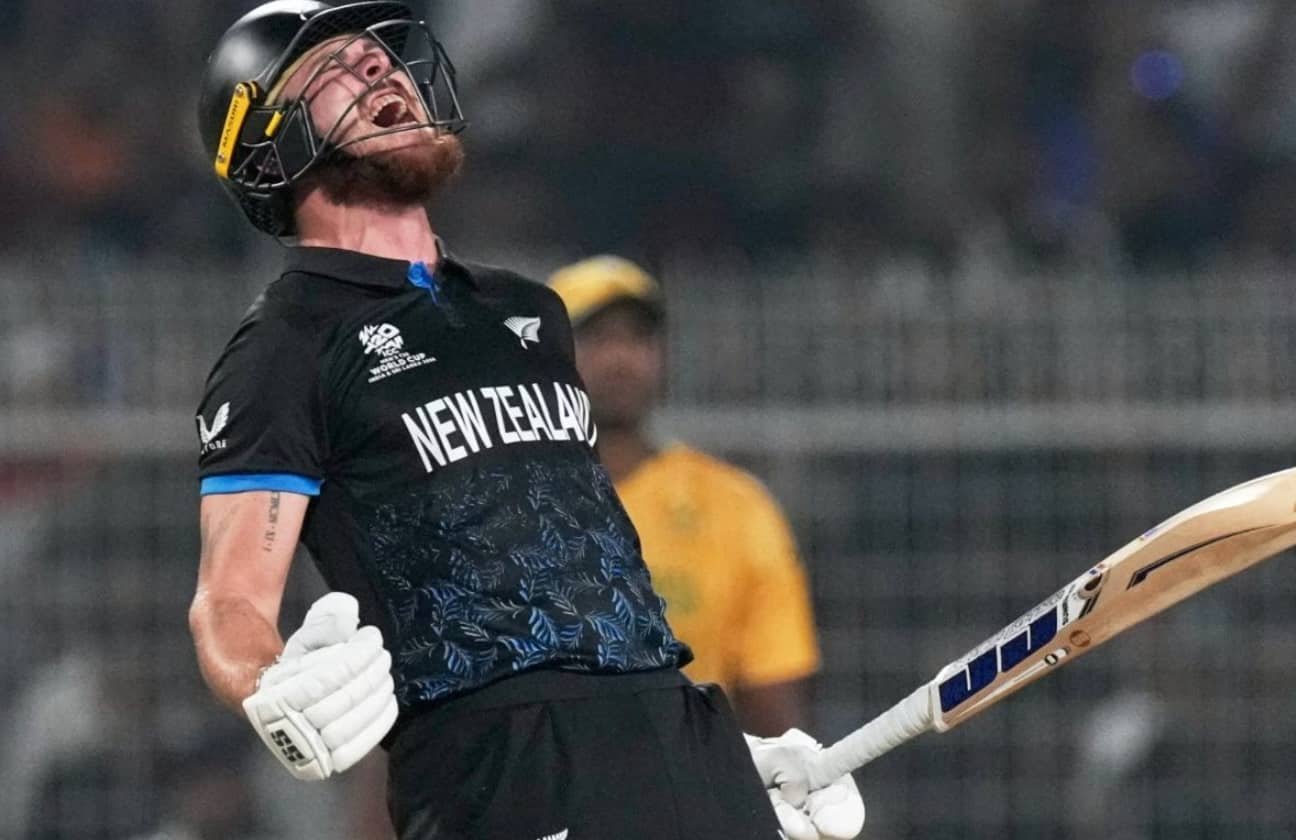
Finn Allen smashed a hundred off just 33 balls in the T20 World Cup semi-final.
That’s the fastest century in T20 World Cup history, breaking Chris Gayle’s record by 14 deliveries.
Allen’s knock came under knockout pressure, which makes it even more remarkable.
Before Allen’s assault, Gayle’s 47-ball century stood as the benchmark for eight years.
Between 2007 and 2026, only six players have scored hundreds inside 53 balls.
Each innings shows the same pattern: sustained boundary hitting, not just late fireworks.
What separates these knocks from ordinary hundreds? They don’t have rebuilding phases.
Most batters consolidate after reaching 50. These guys kept attacking from ball one until they hit three figures.
Fastest Century in T20 World Cup History
Players With the Fastest Century in T20 World Cup
| Player | Team | Balls to 100 | Final Score | 4s | 6s | SR | Opponent | Venue | Date |
|---|---|---|---|---|---|---|---|---|---|
| Finn Allen | New Zealand | 33 | 100* | 10 | 8 | 303.03 | South Africa | Semi-final | 2026 |
| Jacob Bethell | England | 45 | 105 | 8 | 7 | 218.75 | India | Semi-final | 2026 |
| Chris Gayle | West Indies | 47 | 100* | 5 | 11 | 208.33 | England | Wankhede | 16 Mar 2016 |
| Chris Gayle | West Indies | 50 | 117 | 7 | 10 | 205.26 | South Africa | Johannesburg | 11 Sep 2007 |
| Harry Brook | England | 51 | 100 | 10 | 4 | 196.08 | Pakistan | Pallekele | 24 Feb 2026 |
| Brendon McCullum | New Zealand | 51 | 123 | 11 | 7 | 212.06 | Bangladesh | Pallekele | 21 Sep 2012 |
| Rilee Rossouw | South Africa | 52 | 109 | 7 | 8 | 194.64 | Bangladesh | Sydney | 27 Oct 2022 |
| Pathum Nissanka | Sri Lanka | 52 | 100* | 10 | 5 | 192.30 | Australia | Pallekele | 16 Feb 2026 |
Finn Allen (New Zealand) – 33 Balls (2026)
Finn Allen created history in the semi-final. His 33-ball century in t20 world cup 2026 demolished the previous record. The innings came when elimination was on the line.
Allen’s approach didn’t change through the knock. He targeted specific bowlers and stuck to his zones. The boundary frequency never dropped below three per over.
This isn’t just the fastest T20 international century by Indian opposition. It’s the quickest hundred in any T20 World Cup match.
Allen combined power with smart shot selection, hitting gaps when bowlers adjusted their lines.
Jacob Bethell (England) – 45 balls vs India (2026, semi-final)
The second semi-final of the 2026 T20 World Cup witnessed one of the most fearless batting displays in tournament history.
England’s Jacob Bethell walked out with his team chasing a colossal 254 and delivered a performance that will be remembered for generations.
The left-hander dismantled India’s bowling attack with clinical precision, reaching his hundred in a mere 45 balls.
His innings of 105 featured 8 boundaries and 7 maximums, showcasing an array of audacious strokes while wickets tumbled around him.
Though his valiant effort brought England tantalizingly close, India held their nerve to clinch a narrow 7-run victory, turning Bethell’s extraordinary knock into a glorious defeat.
Chris Gayle (West Indies) – 47 Balls (2016)
Gayle held the record for eight years. He reached 100 in 47 balls against England at Wankhede Stadium on 16 March 2016. The innings ended at 100 not out off 48 deliveries.
The knock featured 5 fours and 11 sixes at a strike rate of 208.33. Eleven sixes meant 66 runs came through clearances. That’s sustained aerial assault, not just a few big hits.
Gayle’s hundred came in a group match, not a knockout. But the pressure was real because the West Indies were defending. His innings shifted the momentum completely.
Chris Gayle (West Indies) – 50 Balls (2007)
Gayle’s first World Cup century came in the inaugural tournament. He brought up 100 in 50 balls against South Africa in Johannesburg on 11 September 2007.
The final score reached 117 off 57 balls. He struck 7 fours and 10 sixes at a strike rate of 205.26. Ten sixes in an innings was unheard of in 2007.
This knock set the template for power-hitting in T20 World Cups. Gayle proved that extreme scoring rates were possible even on big tournament stages. The run rate stayed above ten per over throughout.
Harry Brook (England) – 51 balls vs Pakistan (2026)
Harry Brook produced a masterclass in power-hitting during England’s clash with Pakistan at the T20 World Cup 2026.
The Yorkshire batter blended calculated aggression with pristine stroke-play to bring up his century in exactly 51 deliveries.
Brook’s brutal assault featured 10 boundaries and 4 towering sixes, providing the backbone to England’s innings.
His match-winning ton of 100 off 50 balls not only etched his name among the tournament’s fastest centurions but also single-handedly steered his team to victory against Pakistan.
Brendon McCullum (New Zealand) – 51 Balls (2012)
McCullum reached his hundred in 51 balls against Bangladesh at Pallekele on 21 September 2012. He finished with 123 off 58 balls, which included 11 fours and 7 sixes.
His strike rate of 212.06 is the highest among all six fastest hundreds. The boundary split shows balance: 44 runs through fours, 42 through sixes. McCullum didn’t rely on one scoring method.
The innings destroyed Bangladesh’s bowling plans. Captains tried seven different bowlers. None could contain the assault. Field settings became irrelevant when every ball disappeared to the boundary.
Rilee Rossouw (South Africa) – 52 Balls (2022)
Rossouw completed his century in 52 balls against Bangladesh at Sydney on 27 October 2022. He ended with 109 off 56 balls, hitting 7 fours and 8 sixes at a strike rate of 194.64.
Eight sixes show he cleared boundaries regularly through the middle overs. The acceleration didn’t wait for death. By over 15, the game was already gone from Bangladesh’s reach.
South Africa posted over 200, winning by 104 runs. Rossouw’s innings made the margin that wide. One batter’s hundred created a match-winning buffer.
Pathum Nissanka (Sri Lanka) – 52 Balls (2026)
Nissanka reached 100 in 52 balls against Australia at Pallekele on 16 February 2026. He stayed unbeaten on 100 from 52 deliveries while chasing 182.
The innings featured 10 fours and 5 sixes at a strike rate of 192.30. Ten fours suggest he relied more on placement than pure power. Gap-hitting mattered as much as clearing ropes.
Chasing requires different pressure management than batting first. Nissanka controlled the tempo without taking unnecessary risks. The required rate never climbed above eight percent.
Fastest Century in T20 World Cup by Indian
No Indian batter has scored a century inside 53 balls in T20 World Cup matches.
The fastest century in t20 world cup by indian players sits outside this elite group.
India’s World Cup approach focuses on partnerships rather than individual explosions.
The team builds totals through rotation and calculates risks.
This creates a tactical contrast with the all-out assault shown in these record knocks.
Indian batters have scored hundreds in T20 World Cups. But none matched this pace.
The strategic preference leans toward stability in knockout cricket.
Expert Insight: What Makes These Hundreds Different?
These innings share tactical patterns beyond just speed. Boundary frequency stays consistent, not clustered at the end. Six-hitting happens in waves through the middle overs.
Strike rotation between boundaries prevents dot-ball pressure. Bowlers can’t settle into defensive lines when singles come easily. Field placements become reactive, not proactive.
What really separates these knocks? They lack consolidation phases. Normal hundreds include rebuilding periods after wickets fall or during tight overs.
These batters never shifted gears down. They maintained an extreme pace from the first ball to the hundredth run.
The psychological impact matters too. Bowlers who concede boundaries in clusters start doubting their skills.
Captains run out of options when seven bowling changes make no difference. The momentum swing becomes irreversible.
How did Match Situations Shape These Innings?
Each hundred came in different contexts. Gayle’s 2016 knock occurred in a group match while batting first.
McCullum’s century set up a massive total in the powerplay phase.
Rossouw’s hundred pushed South Africa past 200 in a must-win game.
Nissanka’s century chased down a target under scoreboard pressure.
Allen’s semi-final assault came with elimination on the line.
The variety shows these weren’t just statistical achievements.
They directly changed match outcomes.
One batter’s hundred either defended totals, posted massive scores, or chased targets successfully.
FAQs
- Who holds the fastest century in T20 World Cup history?
Finn Allen holds the record with a 33-ball century in the 2026 T20 World Cup semi-final.
- What was Chris Gayle’s fastest T20 World Cup hundred?
Gayle scored a 47-ball century against England at Wankhede Stadium on 16 March 2016.
- Has any Indian scored the fastest century in the T20 World Cup?
No Indian batter has scored a century inside 53 balls in T20 World Cup matches.
- Which player has the highest strike rate among these fastest hundreds?
Brendon McCullum’s 123 off 58 balls has a strike rate of 212.06, the highest among the six fastest centuries.
- How many players have scored centuries under 53 balls in the T20 World Cup?
Six players have achieved this: Finn Allen (33 balls), Chris Gayle (47, 50 balls), Brendon McCullum (51 balls), Rilee Rossouw (52 balls), and Pathum Nissanka (52 balls).
Allen Rewrites T20 World Cup Records
Finn Allen’s 33-ball century stands as the fastest hundred in T20 World Cup history.
His knock broke Chris Gayle’s 47-ball record by 14 deliveries. The semi-final pressure makes it even more remarkable.
Only six players between 2007 and 2026 have reached centuries inside 53 balls.
All struck at rates above 190.
These fastest hundreds show sustained boundary dominance and structured power-hitting at cricket’s highest level.
None relied on late surges. They maintained an extreme pace from start to finish.
Also Check:
- Highest Individual Scores by an Indian in T20 World Cup History
- Batsmen with Most Runs in Single Edition of T20 World Cup
- Highest Team Totals For ICC Men’s T20 World Cup
- Fastest Centuries in T20Is Cricket History
About the Author
